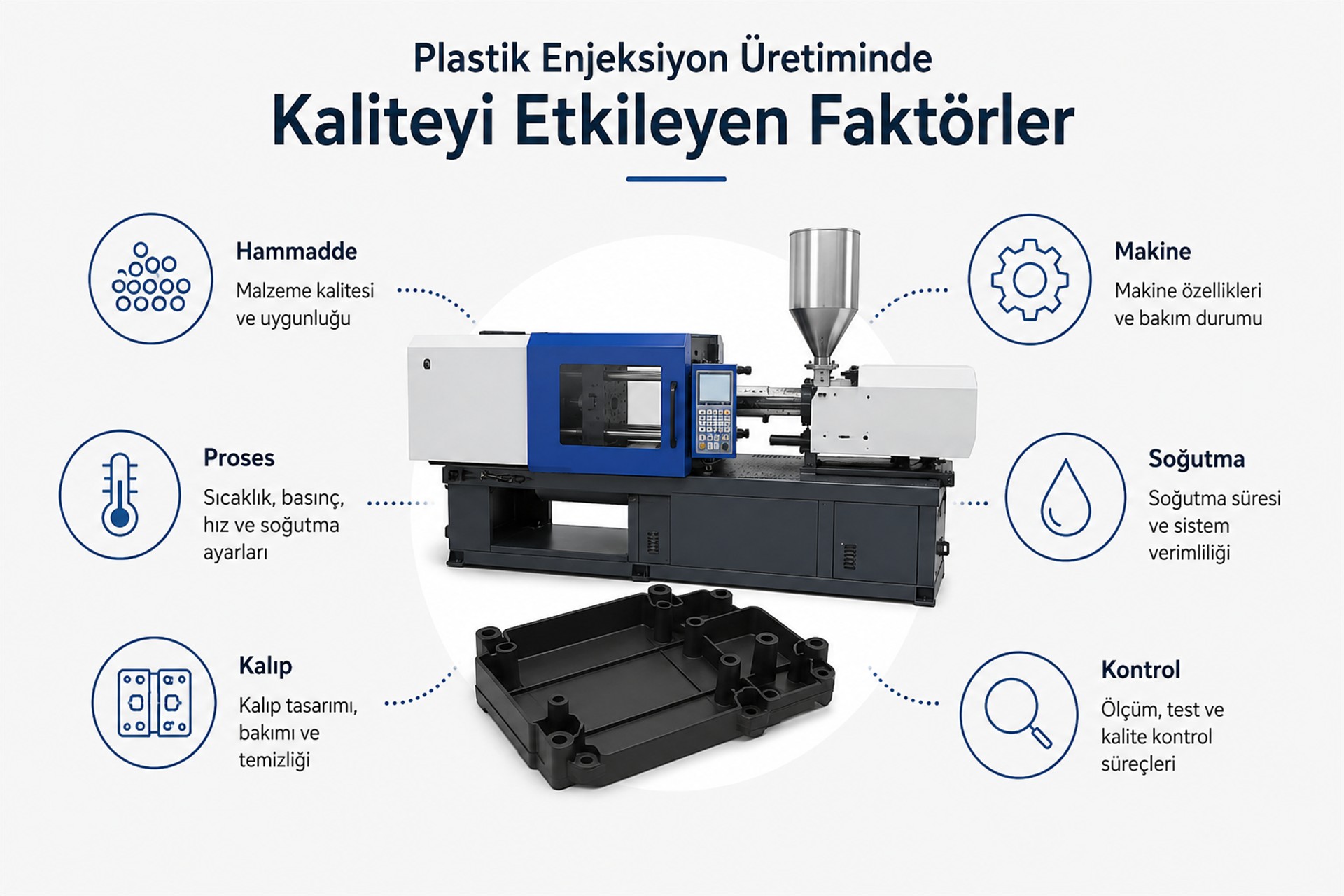
Factors Affecting Quality in Plastic Injection Production
Contact us via Whatsapp
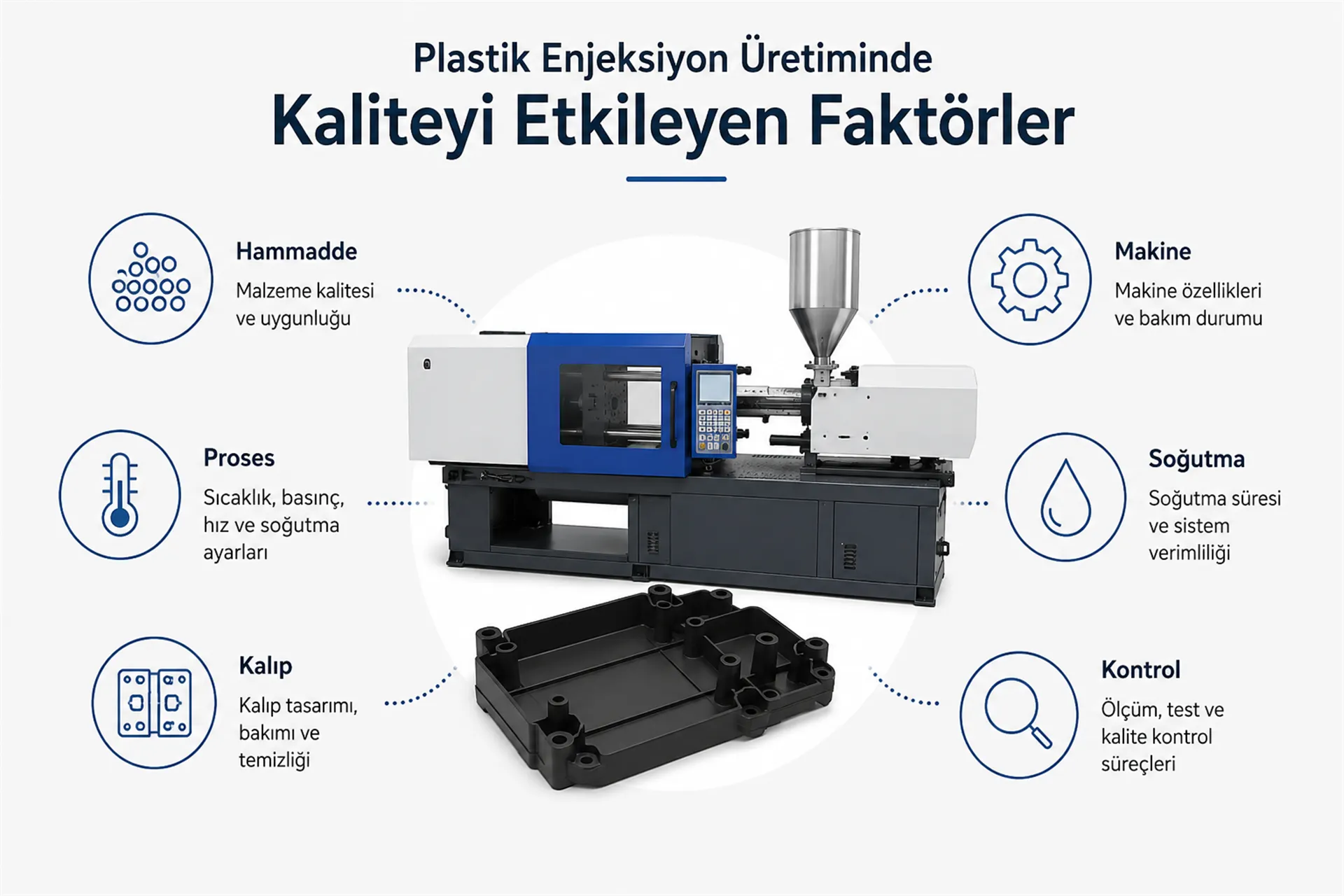
Factors Affecting Quality in Plastic Injection Production
Why is Quality Important in Plastic Injection Manufacturing?
Plastic injection manufacturing is one of the most widely used modern production methods in industries such as automotive, medical, electronics, packaging, home appliances, and defense manufacturing. It provides major advantages thanks to mass production capability, low error rates, and high manufacturing efficiency. However, the quality of produced components depends on many technical factors throughout the manufacturing process.
Quality in plastic injection manufacturing is extremely important in terms of product durability, dimensional accuracy, surface quality, and long-term performance. Even small production errors may lead to high costs, production losses, and customer dissatisfaction. Therefore, every stage of the manufacturing process must be professionally managed to ensure high-quality results.
The Impact of Mold Quality on Production
One of the most important factors affecting quality in plastic injection manufacturing is mold quality. The production precision of the mold, surface finishing, and the quality of steel materials directly determine product quality. Low-quality molds may cause deformation, flash formation, dimensional inaccuracies, and surface defects during production.
Professional mold manufacturing processes use high-precision CNC machining technologies. CAD/CAM-supported production systems enable manufacturing with millimetric accuracy while maintaining quality standards. Proper cooling systems within molds also improve production efficiency and reduce the risk of product deformation.
The Importance of Raw Material Quality
The quality of raw materials used in plastic injection manufacturing directly affects product performance. Poor-quality or incorrectly selected materials may result in cracking, breakage, color inconsistency, and durability issues.
Each industry requires different technical specifications. For this reason, plastic raw materials must be carefully selected according to the intended application of the product. Especially in industrial products requiring high durability, using high-quality materials provides significant long-term advantages.
The Effect of Machines and Production Parameters
The technical capacity of plastic injection machines and properly adjusted production parameters are critical for high-quality manufacturing. Parameters such as injection pressure, mold temperature, cooling time, and injection speed directly affect product quality.
Incorrect production settings may cause deformation, air gaps, burn marks, and dimensional defects. Therefore, production processes should be monitored by experienced professionals and supported by regular quality analysis procedures.
Modern injection molding machines equipped with automation systems provide more precise manufacturing capabilities. This reduces production errors while maintaining consistent quality standards during mass production.
The Importance of Quality Control Processes
Regular quality control procedures are essential for high-quality plastic injection manufacturing. Measurement and testing processes carried out during production help detect potential issues at early stages.
Quality control procedures include dimensional inspections, surface analyses, durability testing, and visual inspections. Maintaining quality standards is especially important in industries requiring high precision and helps companies remain competitive in global markets.
Professional manufacturing facilities use quality management systems to control all production stages and ensure compliance with customer requirements.
The Contribution of Modern Technologies to Plastic Injection Manufacturing
With the advancement of technology, plastic injection manufacturing processes have become more efficient. Robotic systems, automation technologies, and digital manufacturing solutions enable faster and higher-quality production operations.
Industry 4.0 applications allow manufacturers to monitor production processes in real time and minimize manufacturing errors. This helps reduce production costs while increasing customer satisfaction.
Today, the use of modern technologies plays a critical role in achieving high-quality plastic injection manufacturing. High-precision production systems enable companies to meet international quality standards and improve manufacturing performance.